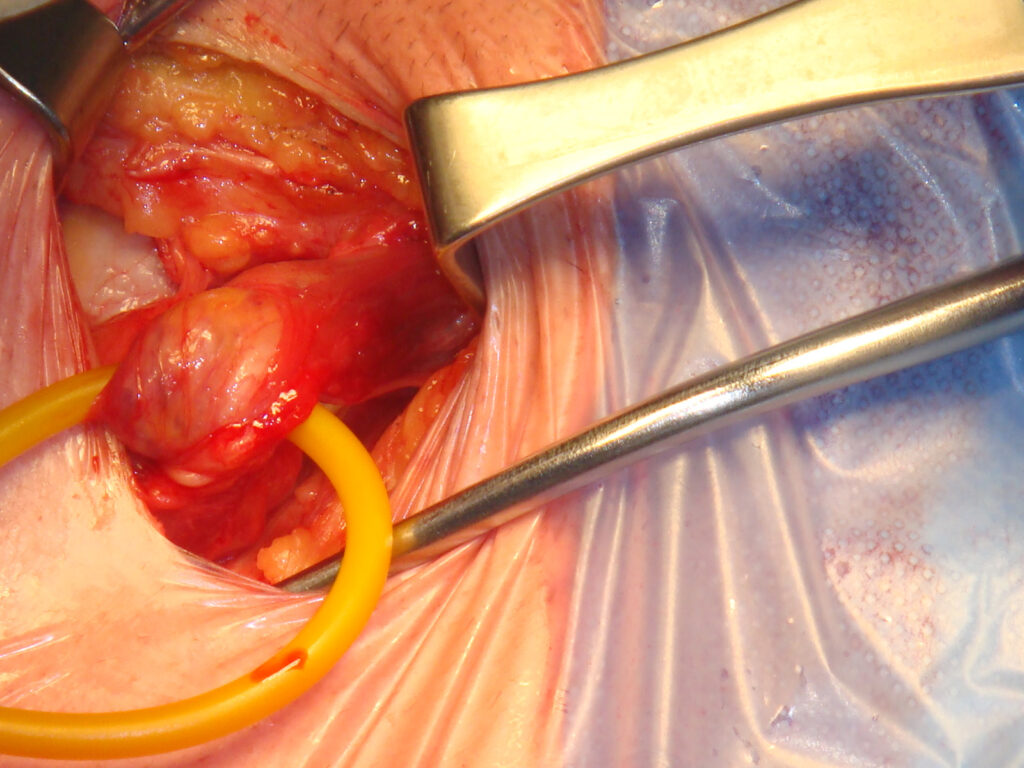
The appropriate treatment for a hernia depends on several factors, including the type and size of the hernia, symptoms, previous surgical history and the patient’s overall health.
During consultation, Dr.Manglik can assess the condition and discuss the appropriate treatment options. Depending on the case, treatment may involve laparoscopic repair, open repair or advanced abdominal wall reconstruction.
The aim is to select an appropriate surgical technique based on the individual patient’s condition rather than applying the same approach to every hernia.
What is a Hernia?
A hernia occurs when an internal organ or tissue pushes through a weak spot or tear in the surrounding muscle or connective tissue wall. Most commonly occurring in the abdomen or groin, a hernia often appears as a noticeable bulge or swelling that may enlarge when coughing, bending, or lifting heavy objects.
Hernias do not heal on their own with medicine or lifestyle changes. Surgical repair is the only definitive treatment to eliminate the bulge and prevent life-threatening complications.
Types of Hernia We Treat
1. Inguinal Hernia (Groin Hernia)
What it is: The most common hernia type, occurring when tissue protrudes into the groin canal. More common in men.
Symptoms: Heavy feeling or aching pain in the groin, visible bulge when standing or coughing.
2. Umbilical &Paraumbilical Hernia
What it is: Occurs near or around the navel (belly button) due to weakness in the abdominal wall.
Who it affects: Common after pregnancy, rapid weight gains, or persistent high abdominal pressure.
3. Ventral & Incisional Hernia
What it is: Develops at the site of a previous surgical scar where the abdominal wall has weakened over time.
Treatment: Requires specialized extraperitoneal or laparoscopic mesh placement to reconstruct wall strength.
4. Hiatal Hernia
What it is: Occurs when the upper part of the stomach pushes upward into the chest cavity through the diaphragm opening.
Symptoms: Chronic heartburn, severe acid reflux (GERD), and difficulty swallowing.
Modern Surgical Techniques Offered
TAPP (Transabdominal Preperitoneal): A keyhole technique allowing full visualization of both sides of the groin to detect occult hernias and secure mesh behind the abdominal wall.
TEP (Totally Extraperitoneal) : Keyhole repair performed entirely outside the peritoneal cavity, avoiding contact with abdominal organs.
eTEP& Abdominal Wall Reconstruction (AWR) : Advanced extraperitoneal procedures for complex, large, or recurrent ventral hernias.
Why Choose Dr. Shresth Manglik for Hernia Surgery?
Specialized interest in advanced hernia surgery
Expertise in laparoscopic hernia repair
Experience with different types of abdominal wall hernias
Focus on complex abdominal wall reconstruction
International training in advanced hernia surgery in Germany
International robotic hernia surgery training in Belgium
Experience in laparoscopic, open and minimally invasive surgical techniques
Academic involvement in hernia surgery and surgical education
Frequently Asked Questions?
Q1. Can a hernia be cured with medications or exercises?
No. Medicines can only relieve symptoms like acidity or mild pain, and exercises can actually worsen the hernia by increasing intra-abdominal pressure. Surgery is the only permanent cure.
Q2. What kind of mesh is used in laparoscopic hernia repair?
We use advanced, lightweight, biocompatible synthetic or semi-absorbable meshes (such as 3D anatomical meshes) designed to reinforce the weak muscle wall permanently without causing stiffness.
Q3. How long will I need to stay in the hospital?
Most laparoscopic hernia repairs are performed as day-care or overnight procedures. Patients are typically discharged within 24 hours.
Q4. When can I resume heavy lifting or exercise after hernia surgery?
You can walk and do light daily activities within 1–2 days. Heavy lifting, intense gym workouts, and strenuous sports can usually be resumed after 4 to 6 weeks.